

Sourcing Surgical Instruments from Sialkot Pakistan
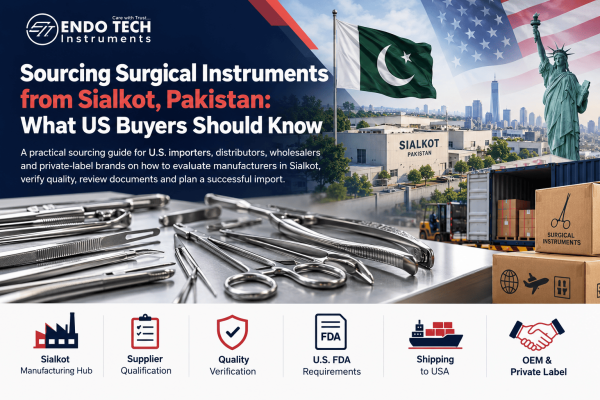
Sourcing Surgical Instruments from Sialkot, Pakistan: What US Buyers Should Know
A practical sourcing guide for U.S. importers, surgical supply distributors, wholesalers and private-label brands evaluating manufacturers in Sialkot, Pakistan. Learn how to compare suppliers, define specifications, check quality records and plan your first or next order.
Sialkot is an established surgical instrument manufacturing and export hub in Pakistan. For a U.S. buyer, the opportunity is access to manufacturers experienced in instrument production and specification-led supply. The key is to verify the individual supplier, the exact products, the quality evidence and the requirements for bringing those devices into the United States.
Quick Answer: How Should US Buyers Source from Sialkot?
Start with a defined product list, catalogue references or drawings, target quantities and U.S. market requirements. Shortlist manufacturers with relevant product experience, request current supplier and product documentation, agree on inspection criteria, evaluate samples where appropriate, and compare written quotations on the same basis.
Do not select a manufacturer based only on a low price, a city-wide reputation or a general certification claim. Confirm the actual supplier's capabilities and the regulatory status applicable to each device you intend to purchase.
1. Why Do Buyers Source Surgical Instruments from Sialkot, Pakistan?
Sialkot has a long-standing surgical instrument manufacturing sector with an export-oriented business model. A 2022 sector brief by Pakistan's Small and Medium Enterprises Development Authority (SMEDA) describes an industry made up of many small and medium-sized manufacturers, with OEM production and overseas buyers supplying specifications or selling instruments under their own brands.
That background is relevant to buyers who need a manufacturing partner rather than a retail seller. However, the sector is not one uniform factory: capabilities, product ranges, inspection practices, documentation and order terms can differ between businesses.
Product-Focused Manufacturing
Buyers can assess manufacturers for specific instrument families, designs, dimensions and production requirements instead of relying only on a broad catalogue.
OEM and Private Label
Depending on the supplier's capabilities, a sourcing project may involve buyer specifications, approved samples, product identification, branding or packaging requirements.
Multiple Product Categories
Sialkot manufacturers serve different instrument segments. Buyers should shortlist companies based on their required products, rather than assuming every factory makes every type.
Direct B2B Discussions
A direct manufacturer enquiry allows buyers to discuss specifications, samples, quality records, quantities and delivery arrangements before placing an order.
For sector context, read the SMEDA Surgical Instruments Sector Brief. The report provides background on the industry; it should not be treated as proof that a specific manufacturer meets your requirements.
2. Identify the Surgical Instrument Categories You Need
Before approaching a manufacturer, define the instruments you plan to source. "Surgical instruments" covers many different product designs and specialties. A buyer looking for ENT forceps has different product and verification requirements from a distributor sourcing orthopedic instruments or surgical retractors.
EndoTech's published product navigation includes the following categories:
ENT Instruments
Identify the required forceps, specula, curettes or other ENT product references.
Surgical Retractors
Specify the retractor design, configuration, dimensions and expected product quantity.
Orthopedic Instruments
Identify the required bone surgery instruments and any critical working-end specifications.
Gynecology Instruments
Prepare a model-level list for the specific instruments and variants you need.
Kerrison Rongeurs
Confirm the required size, configuration and other defined product specifications.
Dental Instruments
Identify the instrument types and product references required for your dental supply range.
Treat these category pages as the starting point for product discovery. Before requesting a quotation, confirm the exact model or catalogue reference, available configuration and current supply details directly with the company.
3. How to Evaluate a Surgical Instrument Manufacturer in Sialkot
A manufacturer should be evaluated against your specific product and order plan. A company profile, factory photograph or product catalogue is useful background, but it does not replace supplier qualification.
-
Verify the business identity.
Confirm the supplier's current legal business name, manufacturing address and the entity that will issue the quotation, invoice and other relevant documents. -
Check product-specific experience.
Send the exact product list and ask which items the supplier can manufacture to the required dimensions, design and configuration. -
Understand the manufacturing arrangement.
Ask which processes are performed in-house and whether any relevant production or finishing activities are outsourced. Clarify how the supplier controls the finished product against your specification. -
Review current supplier documents.
Request the current records applicable to the business, manufacturing location, product and destination market. Check scope, dates and the named entity instead of relying only on a certificate image. -
Agree on quality and delivery expectations.
Document the inspection criteria, sample approval requirements, order quantities, estimated schedule and commercial terms before approving production.
EndoTech provides a Supplier Qualification & Company Profile page for purchasing teams evaluating its business information and supplier documentation.
You can also review the company's Manufacturing Strength page and About EndoTech. Confirm claims and documents relevant to your planned purchase directly with the company.
4. Specify Materials, Dimensions and Product Requirements Before Ordering
Unclear specifications are a common source of quotation differences and order disputes. A product photograph alone may not define all the dimensions, materials, working-end characteristics or acceptance criteria that matter to a B2B buyer.
Prepare one specification for each product or approved product family. Reference drawings, catalogue numbers and approved samples wherever possible.
| Specification Field | What the Buyer Should Define |
|---|---|
| Product identity | Instrument name, catalogue number, SKU and drawing or revision reference. |
| Material | Required material grade or standard, if specified, and any supporting documentation needed. |
| Dimensions | Overall length, working-end dimensions and critical tolerances where applicable. |
| Configuration | Model variant, working end, joint design, handle details and other product-specific features. |
| Finish and workmanship | Agreed surface-finish requirements, markings and applicable workmanship criteria. |
| Identification and packing | SKU identification, package configuration, buyer branding and destination-market labeling requirements. |
| Supporting records | Material records, dimensional inspection reports or other documents required for the order. |
Review EndoTech's Materials, Specifications & Traceability resource when preparing technical questions.
5. Verify Quality Inspection and Sample Approval
A reliable sourcing process defines how product requirements will be checked before the order is approved. Buyers should agree on measurable acceptance criteria rather than depending on general promises such as "premium quality."
- Material verification: Confirm the specified material and identify the records required for the purchase.
- Dimensional inspection: Define the critical dimensions and tolerances relevant to the instrument.
- Workmanship review: Agree on applicable finish, visible defects and instrument-specific characteristics.
- Functional checks: Define any appropriate checks for moving parts, joints, alignment or working ends.
- Final inspection: Clarify who performs the inspection and what records can be provided.
- Nonconformity handling: Agree on how deviations, rejected items and corrective actions will be documented.
Why should buyers review samples?
Sample evaluation can help establish whether a proposed instrument matches the agreed design and specifications before bulk production. Record the sample reference, comments, required corrections and approval status. Make sure production follows the approved version.
For a customized project, the sample approval process should be discussed before the quotation is finalized. Whether samples are available, chargeable or subject to specific lead times must be confirmed with the manufacturer.
Read EndoTech's Quality Assurance & Inspection Process page to prepare your product-specific inspection questions.
6. What US Buyers Should Know About FDA and Import Requirements
Sourcing an instrument from Pakistan does not remove the regulatory responsibilities associated with placing a medical device on the U.S. market. Requirements depend on the exact device, intended use, classification and the roles of the manufacturer, importer and other parties in the supply chain.
Before ordering, identify the applicable pathway for each device. Depending on the product, relevant requirements may involve establishment registration, device listing, quality-system obligations, labeling and a premarket submission or an applicable exemption.
Identify the Device
Confirm the product name, intended use and applicable U.S. device classification. Do not use a broad category name as the only basis for a regulatory decision.
Check Regulatory Status
Verify applicable establishment registration, device listing and any relevant 510(k) clearance, PMA approval or exemption for the specific product.
Review Labeling
Establish which manufacturer details, product identifiers, instructions, warnings and other labeling elements apply to the intended U.S. configuration.
Confirm Importer Roles
Determine which party handles applicable registration, import, recordkeeping and other responsibilities for the particular distribution arrangement.
As of 2026, FDA's Quality Management System Regulation (QMSR) is effective from February 2, 2026. Buyers evaluating device manufacturers should review the applicable FDA requirements and should not treat a certificate alone as proof that all regulatory obligations have been met.
This section is general procurement information, not legal or regulatory advice. Buyers should confirm applicable requirements with qualified regulatory professionals where needed.
7. Sourcing for OEM and Private-Label Surgical Instrument Brands
OEM and private-label sourcing usually requires more coordination than purchasing an established instrument model. A buyer may need to provide a drawing, reference sample, product specifications, branding instructions or packaging artwork.
Before committing to a private-label program, ask the manufacturer to confirm:
- Whether the requested product and configuration can be produced.
- Which drawings, specifications or approved samples will control production.
- What customization, marking, packaging or artwork options are available.
- The minimum order quantity for each product and any development or setup charges.
- What sample approval and inspection records can be provided.
- Which party is responsible for labeling, product claims and applicable regulatory obligations.
A custom design or private label does not automatically transfer every regulatory responsibility to the same party. The roles of manufacturer, specification developer, labeler, importer and brand owner should be reviewed for the intended arrangement.
EndoTech's Supplier Qualification and Ordering, Samples, MOQ & Lead Times pages provide useful starting points for a project discussion.
8. Understand MOQ, Lead Times and Total Sourcing Cost
The lowest unit quotation is not always the lowest-cost sourcing option. Buyers should compare the full commercial arrangement, including the quantity required, product specifications, sample costs, inspection requirements, packaging, freight and applicable import charges.
| Cost or Term | Questions to Resolve Before Ordering |
|---|---|
| Unit pricing | Does the quoted price apply to the exact SKU, specification and quantity? |
| MOQ | Is there a minimum per instrument, per product family or for the complete order? |
| Samples | Are samples available, and are sample charges and shipping costs included? |
| Customization | Are there development, tooling, artwork, marking or setup charges? |
| Production schedule | What is the estimated lead time for the agreed specifications and quantities? |
| Freight and insurance | Which party arranges transport and insurance under the agreed shipping terms? |
| Import costs | Have customs duties, brokerage, taxes and other applicable costs been assessed for the product and shipment? |
MOQ and production lead times can vary by instrument, SKU, customization and current production schedule. Ask for written confirmation instead of assuming one quantity or delivery timeline applies to the full product range.
Review EndoTech's Ordering, Samples, MOQ & Lead Times page before preparing your quotation request.
9. Plan Shipping from Sialkot to the United States
Shipping arrangements should be discussed alongside the quotation, not after production has started. Air and ocean freight can involve different cost, volume and delivery considerations. The appropriate option depends on order size, urgency, goods, packaging and buyer requirements.
Before approving shipment, confirm:
- The agreed dispatch point, destination and delivery terms.
- Who arranges freight, insurance, customs brokerage and import entry.
- Whether the commercial invoice, packing list and other required documents reflect the actual shipment.
- Which product identification and packaging requirements apply.
- Whether regulatory documentation and any required label review are complete.
- The procedure for communicating shipment delays or document discrepancies.
Do not rely on a generic delivery estimate for every order. Request a product- and quantity-specific schedule, and confirm whether the quoted lead time covers production only or also includes shipment arrangements.
U.S. import admissibility and documentation requirements depend on the actual product and transaction. Consult the official FDA medical-device importing guidance and an appropriately qualified customs broker for shipment-specific questions.
10. Red Flags to Check Before Selecting a Supplier
A supplier should be able to provide clear answers about the proposed product and order. The following issues deserve clarification before you release a purchase order.
- The company cannot identify the exact legal manufacturer or business entity supplying the order.
- Product names or specifications remain vague, even after you provide catalogue references or drawings.
- Certificate documents are expired, have an unclear scope or do not identify the relevant entity or site.
- General FDA registration claims are used as a substitute for checking the actual product's regulatory pathway.
- Material requirements, sample acceptance or inspection criteria are left to verbal agreement.
- MOQ, production time, shipping terms or additional charges are not clearly stated.
- The supplier cannot clarify which documents are available for your product and which must be obtained elsewhere.
A red flag does not necessarily mean a supplier is unsuitable, but it does mean the unresolved question should be documented and addressed before proceeding.
11. Use This RFQ Checklist When Contacting a Sialkot Manufacturer
A detailed request for quotation helps the supplier understand your business, identify the products and clarify what is required for the U.S. market. It also gives your purchasing team a consistent basis for comparing manufacturers.
Ask the manufacturer to identify assumptions in its quotation and state any outstanding requirements. Agree on the specification, sample approval, documentation, price, MOQ and delivery terms before authorizing bulk production.
12. How to Start a Sourcing Enquiry with EndoTech
EndoTech Group of Industries identifies Sialkot, Pakistan, as its manufacturing location and publishes product categories, manufacturing information, quality resources and supplier documentation guidance. U.S. buyers can use those resources to prepare an enquiry and then confirm the specific product, current documentation and commercial terms with the company.
Review Manufacturing Information
Understand the manufacturing information published by EndoTech and discuss the processes relevant to your selected instruments.
Prepare Supplier Documents
Identify the company records, product details and quality information needed for your qualification review.
Discuss Quality and Materials
List the exact specifications, inspection criteria and supporting records required for your order.
Clarify U.S. Requirements
Identify the device-specific regulatory information and documentation you need to review before purchasing.
Frequently Asked Questions
Why do US buyers source surgical instruments from Sialkot, Pakistan?
Sialkot has an established, export-oriented surgical instrument manufacturing sector with OEM and specification-led production. Buyers should assess individual manufacturers according to the required products, quality evidence, documentation, commercial terms and applicable U.S. requirements.
How can I verify a surgical instrument manufacturer in Sialkot?
Confirm the business identity and manufacturing location, review relevant product experience, request current supplier and quality documents, define inspection criteria and obtain written confirmation of specifications, MOQ, lead time and order terms.
Can I source OEM or private-label surgical instruments from Pakistan?
Some manufacturers work to buyer specifications and support OEM or private-label projects. Confirm the selected manufacturer's capabilities, product requirements, sample process, minimum quantities, packaging options and regulatory responsibilities before committing to a project.
What documents should a US importer request?
The applicable records depend on the product and transaction. Buyers may need to review establishment registration, device listing, the relevant premarket pathway or exemption, current quality-system documents, technical specifications, labeling and shipment records. Confirm the specific requirements using official FDA guidance and qualified advice where needed.
Does FDA registration mean that a surgical instrument is FDA approved?
No. Establishment registration and device listing do not, by themselves, establish FDA approval, clearance or authorization. The regulatory pathway must be verified for the specific device and intended use.
How is MOQ determined for an instrument order?
MOQ may vary by instrument, SKU, order quantity, customization and manufacturing requirements. Request a written quotation that identifies the applicable minimum quantities and any setup or development charges.
Should I approve a sample before placing a bulk order?
For new models or customized requirements, a documented sample review can help establish whether the proposed product matches the agreed specification. Confirm sample availability and lead time, document any changes, and approve the relevant specification before production.
How do I calculate the cost of importing surgical instruments into the USA?
Start with the product quotation and consider applicable freight, insurance, brokerage, duties, taxes and other shipment-related charges. The final cost depends on the product, quantity, shipping terms, origin and destination. Confirm the applicable import costs with a qualified customs broker.
How do I contact EndoTech about a sourcing project?
Visit the EndoTech Contact page or email info@endotech.com.pk. Include your product references, target quantities, destination market and documentation requirements so the company can review your enquiry.
Looking for a Surgical Instrument Manufacturing Partner in Sialkot?
Share your product list, catalogue references, quantities and U.S. market requirements with EndoTech. Start a focused discussion about product specifications, sample approval, current documentation, quotation and order planning for your B2B sourcing project.
General Enquiries: info@endotech.com.pk | Customer Service: ghafar@endotech.com.pk | Telephone: +92-52-4352088